
How to Actually Leverage AI to Help Your DTC Brand Become Profitable
Dedicated to the brands looking at margins instead of just their revenue screenshots.

Common Ground is Ground’s newsletter highlighting the most important consumer news, tech trends, artificial intelligence, in-depth analysis, along with a few extra thoughts from our team. Subscribe today to get the latest issue delivered to your inbox.

There are enough founders who know the pattern by now.
We’ve sat in a good number of calls with founders that go something like this: Someone shows us a revenue screenshot.
It looks great.
Then we get one layer deeper, and suddenly cash flow is tight, margins are thin, and every month feels like survival instead of scale.
We’ve learned the hard way that a good revenue number can hide a bad business. Profit is what keeps a brand alive.
The instinct when profit is thin is almost always to fix acquisition: lower the CAC, find a cheaper channel, cut the ad budget. It’s the number everyone’s staring at. But it’s usually not where the actual leak is.
There’s a LinkedIn post that compared 50 dead DTC brands (Allbirds, Casper, Bonobos, Outdoor Voices) to a graveyard which was quite interesting. Completely different products, completely different categories, same cause of death: they built the whole business around buying customers cheaply through Facebook and Instagram, and never fixed what happened after checkout.
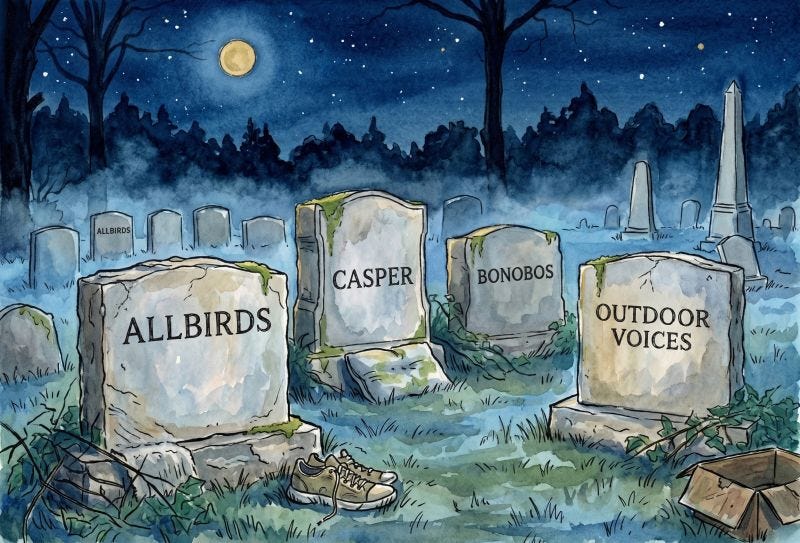
That worked right up until ad costs caught up with them (CAC climbed 222% between 2013 and 2022), and the traffic that had been propping up the whole model dried up with it.
The math underneath is brutal. The average DTC brand loses about $29 on a customer’s first order once you account for ad spend and returns. Only 27% of first-time buyers ever place a second order. The other 73% leave before you’ve earned back what you spent to get them.
What moves this number? In short: data. In long: an AI that learns from every transaction and gets smarter over time - so it knows the moment an existing customer is ready to buy again or ready to explore something new.
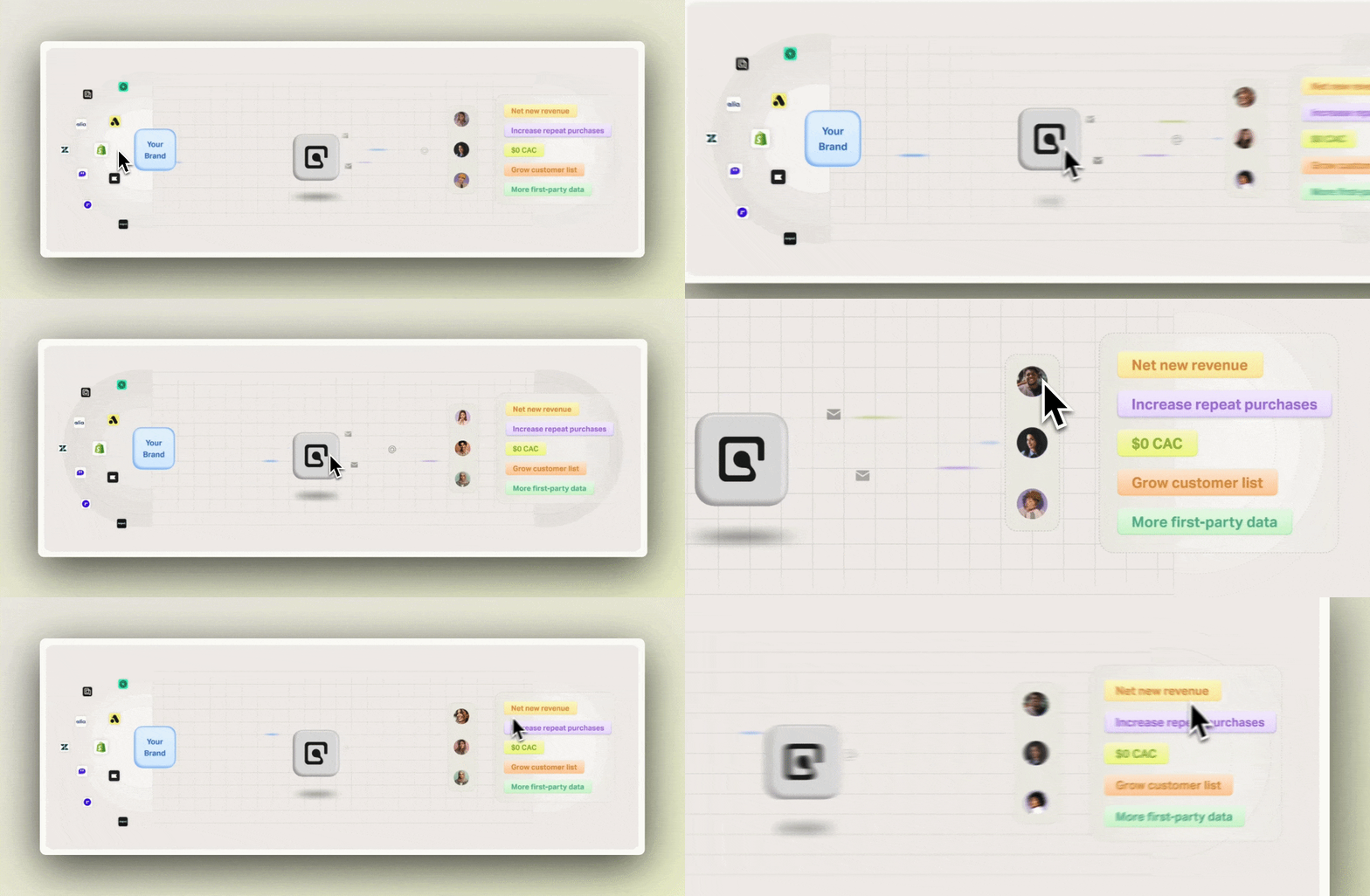
Ground is what that looks like in practice. Three AI models working together as a brain across your full customer journey: bringing in high-intent buyers, converting them on site, and compounding retention over time. It plugs into your existing stack in 15 minutes. No data science team. No technical lift. Just intelligence that starts working from day one.

Why “profitable” got harder to see, not just harder to achieve
The brands doing this well aren’t necessarily smarter, they’ve just built the visibility to act early instead of reacting late. Real-time sell-through data lets teams shift investment into what's working while there's still time left in the season to react, instead of finding out three months later in a spreadsheet. That's the muscle DTC brands like U Beauty, Orebella, Nodpod, The great and hundreds more have already built using Ground’s Rebeat AI.
Where AI actually moves the needle
So where does AI help, concretely? Not by making ads cheaper. By making the after visible and personal:
Predicting who’s about to leave, before they leave. Instead of a reactive win-back email three weeks after someone’s already checked out mentally, AI can catch the churn signal early enough to actually act on it with dynamic blocks and messaging.
Replacing blanket discounts with the right offer for the right person. A sitewide “20% off, last chance” trains your best customers to wait for the next one and quietly erodes your positioning. A model that knows who actually needs the nudge (and who was going to buy anyway) protects both margin and brand.
Giving you real-time contribution margin visibility, not just revenue, per SKU and per cohort, so decisions happen while there’s still time to act on them instead of after the quarter closes.
Forecasting demand instead of guessing at it, so cash doesn’t sit trapped in overstock waiting for a markdown to move it.
Personalizing the retention layer itself - loyalty perks, subscription cadence, post-purchase content - the same way strong omnichannel brands retain 89% of customers compared to 33% for brands with a weak one.
These are all why we built Ground. Ground accounts for 10% of DTC revenue for the brands we work with. That number grows as the AI models learn. The brands that moved early are now the ones with the compounding advantage.
The honest caveat
None of this works if you’re just adding another AI tool because it’s trendy. If it doesn’t improve retention or margin, it’s overhead with better branding - and at that point the brand might as well skip the tool entirely than bolt one on and call it a strategy.
This is exactly the gap Ground was built to close - Where most DTC brands are still flying blind between campaigns, Ground's AI agents work continuously in the background capturing high-intent visitors who slipped through the first time, re-identifying returning shoppers whose cookie data has expired, and surfacing the right product to the right customer at the right moment. The result isn't just more automation. It's better visibility into who's on your site, what they want, and when to reach them - turning traffic you're already paying for into revenue you were previously leaving on the table.
If you’re curious about learning more, let’s chat.

Curated Intelligence
Why Analytics and Agility Are Critical to Success in Today’s Retail Market Read More
D2C’s Profitability Crisis Has 1 Root Cause: Focus on Acquisition, Instead of Loyalty Read More
The Fashion Marketer’s Guide to AI Read More
💡 Prompt Smarter
Did you know: you can ask an AI model to calculate your true contribution margin per SKU right now, if you feed it your CAC, discount rate, shipping cost, and return rate by product line. Most brands have never seen that number broken out this granularly, and it usually tells a very different story than top-line revenue does.
Finding Common Ground
The Ground community comes together sharing different stories, but common ground.
 | A guest post by
|
The leak framing is right, and there is a version of it before the first order. In 197 stores I audited, 39 had broken or missing product schema, which means the machine reading the catalog gets a worse picture of the assortment than a returning customer does. Any model that learns from transactions is only as good as what the catalog says about the items being transacted. Retention gets the attention because it is measurable, but the same data quality problem sits one step earlier and nobody prices it.